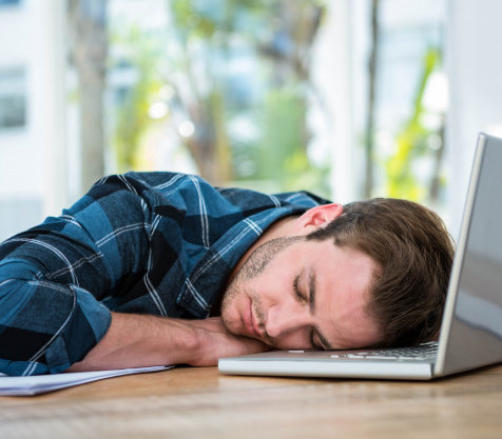
Working Adults Don't Get Enough Sleep
and It Impacts Productivity
Methodology
2,000 surveys were fielded between April 10-18, 2019 among a representative sample of Respondent adults (age 18+), using
a questionnaire lasting approximately 15 minutes. Sample size provides a confidence interval of ±2.19% at 95%. The
sample was provided by Dynata, one of the largest online sample providers in the world.
Respondent Profile
Gender
%
Age
%
Generation
%
Region
%
Male
49%
18-24
14%
Gen Z (18-22)
8%
South
37%
Female
51%
25-34
19%
Millennials (23-38)
32%
Midwest
23%
35-44
18%
Gen X (39-54)
28%
Northeast
21%
45-54
17%
Boomers (55-73)
27%
West
19%
55+
32%
Silents (74+)
5%
Sleep Index
Analysis was conducted to establish a Sleep Index (SI) that can be used to track Respondents sleep quality over time. The SI is
calculated using the following questions:
Q2. On average, how would you describe your sleep within the past two weeks?
Excellent
Very Good
Good
Fair
Poor
5
4
3
2
1
Q7. Within the past two weeks, how often have you felt the following when you wake up in the morning?
Frequently
Often
Occasionally
Rarely
Never
(10 to 14 times)
(6 to 9 times)
(3 to 5 times)
(1 to 2 times)
Tired (want to continue sleeping)
1
2
3
4
5
Rested/refreshed
5
4
3
2
1
The multiplicative index was scaled so the average score was 100. The index was used to create three
groups, as depicted below, for analysis purposes.
All Adults
Poor Sleepers
Average Sleepers
Excellent Sleepers
(SI< 90
(SI > 90 and SI < 110
(SI > 110)
56%
11%
33%
Work and Sleep Research Findings
According to our survey, Respondent adults say they need 7.18 hours of sleep on average a night to feel productive
at work the next day. However, people who work don’t get this amount of sleep.
Employed adults sleep an average of 6.84 hours per night
More than one-third of them (41%) get less than 7 hours of sleep per night
Over half of them (54%) often or frequently wake up feeling tired
Employed adults are less likely to be “excellent sleepers” than the adult population at large.
Poor Sleepers Average Sleepers Excellent Sleepers
(SI > 90 (SI > 90 and SI < 110
(SI > 110)
All Adults 56%
11% 33%
Employed Adults
57%
14%
29%
Various surveys suggests that work-related circumstances correlated with poor sleep. Employers who develop strategies to
alleviate these work-related stress-ors should expect a positive impact on their employees’ sleep
and increased productivity. Alternatively, employees who suffer work-related stress can change employers
and seek a work culture that is more conducive to better sleep, improving their productivity by the same token.
Work-Related Factors That Impact Employees’ Sleep Negatively
Pressure at work
Employees who agree (somewhat or completely) that they are under pressure at work represent 44% of poor sleepers/30% of
excellent sleepers. (Workers who are poor sleepers are 1.5 times more likely to feel under
pressure at work.)
Not feeling valued at work
Employees who disagree (somewhat or completely) that they feel valued at work represent 22% of poor
sleepers/9% of excellent sleepers. (Workers who are poor sleepers are more than twice as likely [2.4] to
not feel valued at work.)
Not enjoying work
Employees who disagree (somewhat or completely) that they enjoy the work they do represent 18% of poor sleepers/8% of
excellent sleepers. (Workers who are poor sleepers are more than twice as likely [2.3] to
not enjoy the work they do.)
Not feeling respected at work
Employees who disagree (somewhat or completely) that they work in a respectful environment represent 14% of poor
sleepers/5% of excellent sleepers. (Workers who are poor sleepers are nearly three times as
likely [2.8] to not work in a respectful environment.)
Not enjoying co-workers
Employees who disagree (somewhat or completely) that they enjoy their colleagues represent 11% of poor sleepers/5% of
excellent sleepers. (Workers who are poor sleepers are twice as likely [2.2] to not enjoy their co-workers.)
Not working in a friendly environment
Employees who disagree (somewhat or completely) that they work in a friendly environment make up 12% of
poor sleepers/4% of excellent sleepers. (Workers who are poor sleepers are three times more likely to not
work in a friendly environment.)
Other factors outside of work also impact employees’ sleep. Employers and employees alike can have an impact
on these factors to improve sleep and impact productivity at work. For example, employers who educate
staff about ways to improve their sleep and develop strategies to help employees gain better sleep should be rewarded with
improved productivity.
Non-Work-Environment-Related Factors That Impact Employees’ Sleep Negatively
Nightly routines detrimental to sleep:
Checking social media right before bed (poor sleepers 43%/excellent 36%)
Watching TV right before bed (poor sleepers 68%/excellent 59%) and/or sleep with the TV on (poor sleepers
32%/excellent 25%)
Eating a snack right before bed (poor sleepers 21%/excellent 16%) and/or have their last meal one hour
or less before bed (poor sleepers 23%/excellent 16%). (Workers who are poor sleepers are 1.3 times more
likely to eat a snack before bed and are 1.4 times more likely to have their last meal one hour or less before bed.)
Not meditating (or praying) right before bed (poor sleepers 15%/excellent 21%). (Workers who are poor sleepers are
1.4 times less likely to meditate/pray before bed.)
Using over-the-counter or prescription medication to help fall asleep often or frequently (poor sleepers
15%/excellent 8%). (Workers who are poor sleepers are nearly two times [1.9 times] more likely to use
medication to help them fall asleep.)
The absence of leisure activities also impact sleep negatively:
Employed adults who agree (somewhat or completely) with enjoying the weekend at home and not going out represent 75%
of poor sleepers/69% of excellent sleepers
Employed adults who disagree (somewhat or completely) with enjoying the following hobbies are more
likely to sleep poorly:
Meeting new people (poor sleepers 24%/excellent 16%)
Exercising (poor sleepers 22%/excellent 16%)
Participating in sports/competitive activities (poor sleepers 49%/excellent 38%)
Watching sports on TV (poor sleepers 38%/excellent 25%)
Watching sports in-person (poor sleepers 37%/excellent 25%)
Gardening (poor sleepers 41%/excellent 32%)
Attending live plays/theater (poor sleepers 34%/excellent 23%)
Attending live concerts (poor sleepers 25%/excellent 19%)
Participating in sports/competitive activities (poor sleepers 49%/excellent 38%)






Even though we have taken all the care for accuracy of facts we highly
recommend you see your doctor for professional advise and diagnosis.
1
2
3
4
5
6
Learn how work-related circumstances
correlate with poor sleep.
This Website was produced by
CHIROPEDICSA
Bedding company
for your information on the
importance of a good night sleep



Working Adults Don't Get Enough
Sleep and It
Impacts Productivity.
Methodology
2,000 surveys were fielded between April 10-18, 2019 among a representative sample of Respondent adults (age 18+),
using a questionnaire lasting approximately 15 minutes. Sample size provides a confidence interval of ±2.19% at 95%. The
sample was provided by Dynata, one of the largest online sample providers in the world.
Respondent Profile
Gender
%
Age
%
Generation
%
Region
%
Male
49%
18-24
14%
Gen Z (18-22)
8%
South
37%
Female
51%
25-34
19%
Millennials (23-38)
32%
Midwest
23%
35-44
18%
Gen X (39-54)
28%
Northeast
21%
45-54
17%
Boomers (55-73)
27%
West
19%
55+
32%
Silents (74+)
5%
Sleep Index
Analysis was conducted to establish a Sleep Index (SI) that can be used to track America’s sleep quality over time. The SI is
calculated using the following questions:
Q2. On average, how would you describe your sleep within the past two weeks?
Excellent
Very Good
Good
Fair
Poor
5
4
3
2
1
Q7. Within the past two weeks, how often have you felt the following when you wake up in the morning?
Frequently
Often
Occasionally
Rarely
Never
(10 to 14 times)
(6 to 9 times)
(3 to 5 times)
(1 to 2 times)
Tired (want to continue sleeping)
1
2
3
4
5
Rested/refreshed
5
4
3
2
1
The multiplicative index was scaled so the average score was 100. The index was used to create three groups, as
depicted below, for analysis purposes.
All Adults
Poor Sleepers
Average Sleepers
Excellent Sleepers
(SI< 90
(SI > 90 and SI < 110
(SI > 110)
56%
11%
33%
Work and Sleep Research Findings
According to our survey, Respondent adults say they need 7.18 hours of sleep on average a night to feel productive at work
the next day. However, people who work don’t get this amount of sleep.
Employed adults sleep an average of 6.84 hours per night
More than one-third of them (41%) get less than 7 hours of sleep per night
Over half of them (54%) often or frequently wake up feeling tired
Employed adults are less likely to be “excellent sleepers” than the adult population at large.
Poor Sleepers Average Sleepers Excellent Sleepers
(SI > 90 (SI > 90 and SI < 110
(SI > 110)
All Adults 56%
11% 33%
Employed Adults
57%
14%
29%
Various surveys suggests that work-related circumstances correlated with poor sleep. Employers who develop strategies to
alleviate these work-related stress-ors should expect a positive impact on their employees’ sleep and increased productivity.
Alternatively, employees who suffer work-related stress can change employers and seek a work culture that is more
conducive to better sleep, improving their productivity by the same token.
Work-Related Factors That Impact Employees’ Sleep Negatively
Pressure at work
Employees who agree (somewhat or completely) that they are under pressure at work represent 44% of poor sleepers/30% of
excellent sleepers. (Workers who are poor sleepers are 1.5 times more likely to feel under pressure at work.)
Not feeling valued at work
Employees who disagree (somewhat or completely) that they feel valued at work represent 22% of poor sleepers/9% of
excellent sleepers. (Workers who are poor sleepers are more than twice as likely [2.4] to not feel valued at work.)
Not enjoying work
Employees who disagree (somewhat or completely) that they enjoy the work they do represent 18% of poor sleepers/8% of
excellent sleepers. (Workers who are poor sleepers are more than twice as likely [2.3] to not enjoy the work they do.)
Not feeling respected at work
Employees who disagree (somewhat or completely) that they work in a respectful environment represent 14% of poor
sleepers/5% of excellent sleepers. (Workers who are poor sleepers are nearly three times as likely [2.8] to not work in a
respectful environment.)
Not enjoying co-workers
Employees who disagree (somewhat or completely) that they enjoy their colleagues represent 11% of poor sleepers/5% of
excellent sleepers. (Workers who are poor sleepers are twice as likely [2.2] to not enjoy their co-workers.)
Not working in a friendly environment
Employees who disagree (somewhat or completely) that they work in a friendly environment make up 12% of poor
sleepers/4% of excellent sleepers. (Workers who are poor sleepers are three times more likely to not work in a friendly
environment.)
Other factors outside of work also impact employees’ sleep. Employers and employees alike can have an impact on these
factors to improve sleep and impact productivity at work. For example, employers who educate staff about ways to improve
their sleep and develop strategies to help employees gain better sleep should be rewarded with improved productivity.
Non-Work-Environment-Related Factors That Impact Employees’ Sleep Negatively
Nightly routines detrimental to sleep:
Checking social media right before bed (poor sleepers 43%/excellent 36%)
Watching TV right before bed (poor sleepers 68%/excellent 59%) and/or sleep with the TV on (poor sleepers
32%/excellent 25%)
Eating a snack right before bed (poor sleepers 21%/excellent 16%) and/or have their last meal one hour or less before
bed (poor sleepers 23%/excellent 16%). (Workers who are poor sleepers are 1.3 times more likely to eat a snack before bed
and are 1.4 times more likely to have their last meal one hour or less before bed.)
Not meditating (or praying) right before bed (poor sleepers 15%/excellent 21%). (Workers who are poor sleepers are
1.4 times less likely to meditate/pray before bed.)
Using over-the-counter or prescription medication to help fall asleep often or frequently (poor sleepers
15%/excellent 8%). (Workers who are poor sleepers are nearly two times [1.9 times] more likely to use medication to help
them fall asleep.)
The absence of leisure activities also impact sleep negatively:
Employed adults who agree (somewhat or completely) with enjoying the weekend at home and not going out represent 75%
of poor sleepers/69% of excellent sleepers
Employed adults who disagree (somewhat or completely) with enjoying the following hobbies are more likely to sleep poorly:
Meeting new people (poor sleepers 24%/excellent 16%)
Exercising (poor sleepers 22%/excellent 16%)
Participating in sports/competitive activities (poor sleepers 49%/excellent 38%)
Watching sports on TV (poor sleepers 38%/excellent 25%)
Watching sports in-person (poor sleepers 37%/excellent 25%)
Gardening (poor sleepers 41%/excellent 32%)
Attending live plays/theater (poor sleepers 34%/excellent 23%)
Attending live concerts (poor sleepers 25%/excellent 19%)
Participating in sports/competitive activities (poor sleepers 49%/excellent 38%)


This Website was produced by
CHIROPEDICSA
Bedding company
for your information on the
importance of a good night sleep
Even though we have taken all the care for accuracy of facts we highly
recommend you see your doctor for professional advise and diagnosis.
1
2
3
4
5
6
Learn how work-related circumstances
correlate with poor sleep.





Working Adults Don't Get Enough
Sleep and It
Impacts Productivity.



This Website was produced by
CHIROPEDICSA
Bedding company
for your information on the
importance of a good night sleep
Even though we have taken all the care for accuracy of facts we highly
recommend you see your doctor for professional advise and diagnosis.
1
2
3
4
5
6
Learn how work-related circumstances
correlate with poor sleep.


Methodology
2,000 surveys were fielded between April 10-18, 2019 among a representative sample of Respondent adults (age 18+),
using a questionnaire lasting approximately 15 minutes. Sample size provides a confidence interval of ±2.19% at 95%. The
sample was provided by Dynata, one of the largest online sample providers in the country.
Respondent Profile
Gender
%
Age
%
Generation
%
Region
%
Male
49%
18-24
14%
Gen Z (18-22)
8%
South
37%
Female
51%
25-34
19%
Millennials (23-38)
32%
Midwest
23%
35-44
18%
Gen X (39-54)
28%
Northeast
21%
45-54
17%
Boomers (55-73)
27%
West
19%
55+
32%
Silents (74+)
5%
Sleep Index
Analysis was conducted to establish a Sleep Index (SI) that can be used to track America’s sleep quality over time. The SI is
calculated using the following questions:
Q2. On average, how would you describe your sleep within the past two weeks?
Excellent
Very Good
Good
Fair
Poor
5
4
3
2
1
Q7. Within the past two weeks, how often have you felt the following when you wake up in the morning?
Frequently
Often
Occasionally
Rarely
Never
(10 to 14 times)
(6 to 9 times)
(3 to 5 times)
(1 to 2 times)
Tired (want to continue sleeping)
1
2
3
4
5
Rested/refreshed
5
4
3
2
1
The multiplicative index was scaled so the average score was 100. The index was used to create three groups, as
depicted below, for analysis purposes.
All Adults
Poor Sleepers
Average Sleepers
Excellent Sleepers
(SI< 90
(SI > 90 and SI < 110 (SI > 110)
56%
11%
33%
Work and Sleep Research Findings
According to our survey, Respondent adults say they need 7.18 hours of sleep on average a night to feel productive at work
the next day. However, people who work don’t get this amount of sleep.
Employed adults sleep an average of 6.84 hours per night
More than one-third of them (41%) get less than 7 hours of sleep per night
Over half of them (54%) often or frequently wake up feeling tired
Employed adults are less likely to be “excellent sleepers” than the adult population at large.
Poor Sleepers Average Sleepers Excellent Sleepers
(SI > 90 (SI > 90 and SI < 110
(SI > 110)
All Adults 56%
11% 33%
Employed Adults
57%
14%
29%
Various surveys suggests that work-related circumstances correlated with poor sleep. Employers who develop strategies to
alleviate these work-related stress-ors should expect a positive impact on their employees’ sleep and increased productivity.
Alternatively, employees who suffer work-related stress can change employers and seek a work culture that is more
conducive to better sleep, improving their productivity by the same token.
Work-Related Factors That Impact Employees’ Sleep Negatively
Pressure at work
Employees who agree (somewhat or completely) that they are under pressure at work represent 44% of poor sleepers/30% of
excellent sleepers. (Workers who are poor sleepers are 1.5 times more likely to feel under pressure at work.)
Not feeling valued at work
Employees who disagree (somewhat or completely) that they feel valued at work represent 22% of poor sleepers/9% of
excellent sleepers. (Workers who are poor sleepers are more than twice as likely [2.4] to not feel valued at work.)
Not enjoying work
Employees who disagree (somewhat or completely) that they enjoy the work they do represent 18% of poor sleepers/8% of
excellent sleepers. (Workers who are poor sleepers are more than twice as likely [2.3] to not enjoy the work they do.)
Not feeling respected at work
Employees who disagree (somewhat or completely) that they work in a respectful environment represent 14% of poor
sleepers/5% of excellent sleepers. (Workers who are poor sleepers are nearly three times as likely [2.8] to not work in a
respectful environment.)
Not enjoying co-workers
Employees who disagree (somewhat or completely) that they enjoy their colleagues represent 11% of poor sleepers/5% of
excellent sleepers. (Workers who are poor sleepers are twice as likely [2.2] to not enjoy their co-workers.)
Not working in a friendly environment
Employees who disagree (somewhat or completely) that they work in a friendly environment make up 12% of poor
sleepers/4% of excellent sleepers. (Workers who are poor sleepers are three times more likely to not work in a friendly
environment.)
Other factors outside of work also impact employees’ sleep. Employers and employees alike can have an impact on these
factors to improve sleep and impact productivity at work. For example, employers who educate staff about ways to improve
their sleep and develop strategies to help employees gain better sleep should be rewarded with improved productivity.
Non-Work-Environment-Related Factors That Impact Employees’ Sleep Negatively
Nightly routines detrimental to sleep:
Checking social media right before bed (poor sleepers 43%/excellent 36%)
Watching TV right before bed (poor sleepers 68%/excellent 59%) and/or sleep with the TV on (poor sleepers
32%/excellent 25%)
Eating a snack right before bed (poor sleepers 21%/excellent 16%) and/or have their last meal one hour or less before
bed (poor sleepers 23%/excellent 16%). (Workers who are poor sleepers are 1.3 times more likely to eat a snack before bed
and are 1.4 times more likely to have their last meal one hour or less before bed.)
Not meditating (or praying) right before bed (poor sleepers 15%/excellent 21%). (Workers who are poor sleepers are
1.4 times less likely to meditate/pray before bed.)
Using over-the-counter or prescription medication to help fall asleep often or frequently (poor sleepers
15%/excellent 8%). (Workers who are poor sleepers are nearly two times [1.9 times] more likely to use medication to help
them fall asleep.)
The absence of leisure activities also impact sleep negatively:
Employed adults who agree (somewhat or completely) with enjoying the weekend at home and not going out represent 75%
of poor sleepers/69% of excellent sleepers
Employed adults who disagree (somewhat or completely) with enjoying the following hobbies are more likely to sleep poorly:
Meeting new people (poor sleepers 24%/excellent 16%)
Exercising (poor sleepers 22%/excellent 16%)
Participating in sports/competitive activities (poor sleepers 49%/excellent 38%)
Watching sports on TV (poor sleepers 38%/excellent 25%)
Watching sports in-person (poor sleepers 37%/excellent 25%)
Gardening (poor sleepers 41%/excellent 32%)
Attending live plays/theater (poor sleepers 34%/excellent 23%)
Attending live concerts (poor sleepers 25%/excellent 19%)
Participating in sports/competitive activities (poor sleepers 49%/excellent 38%)